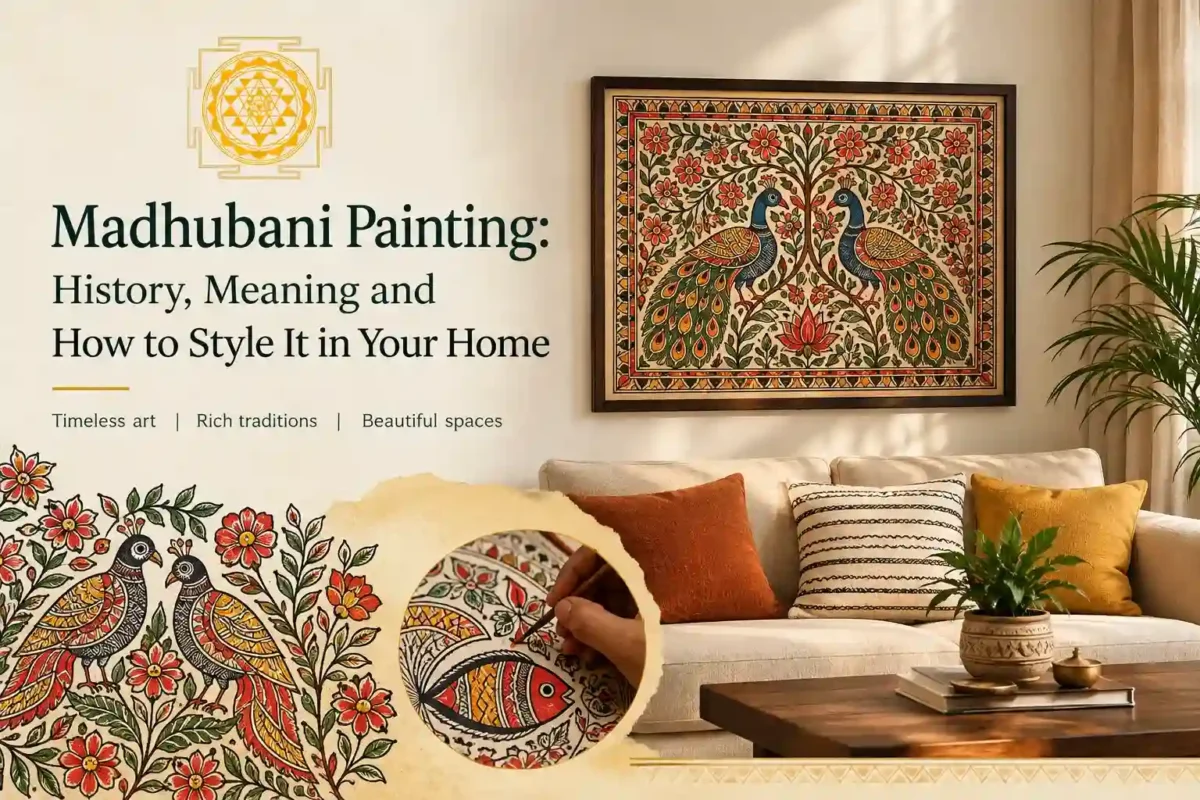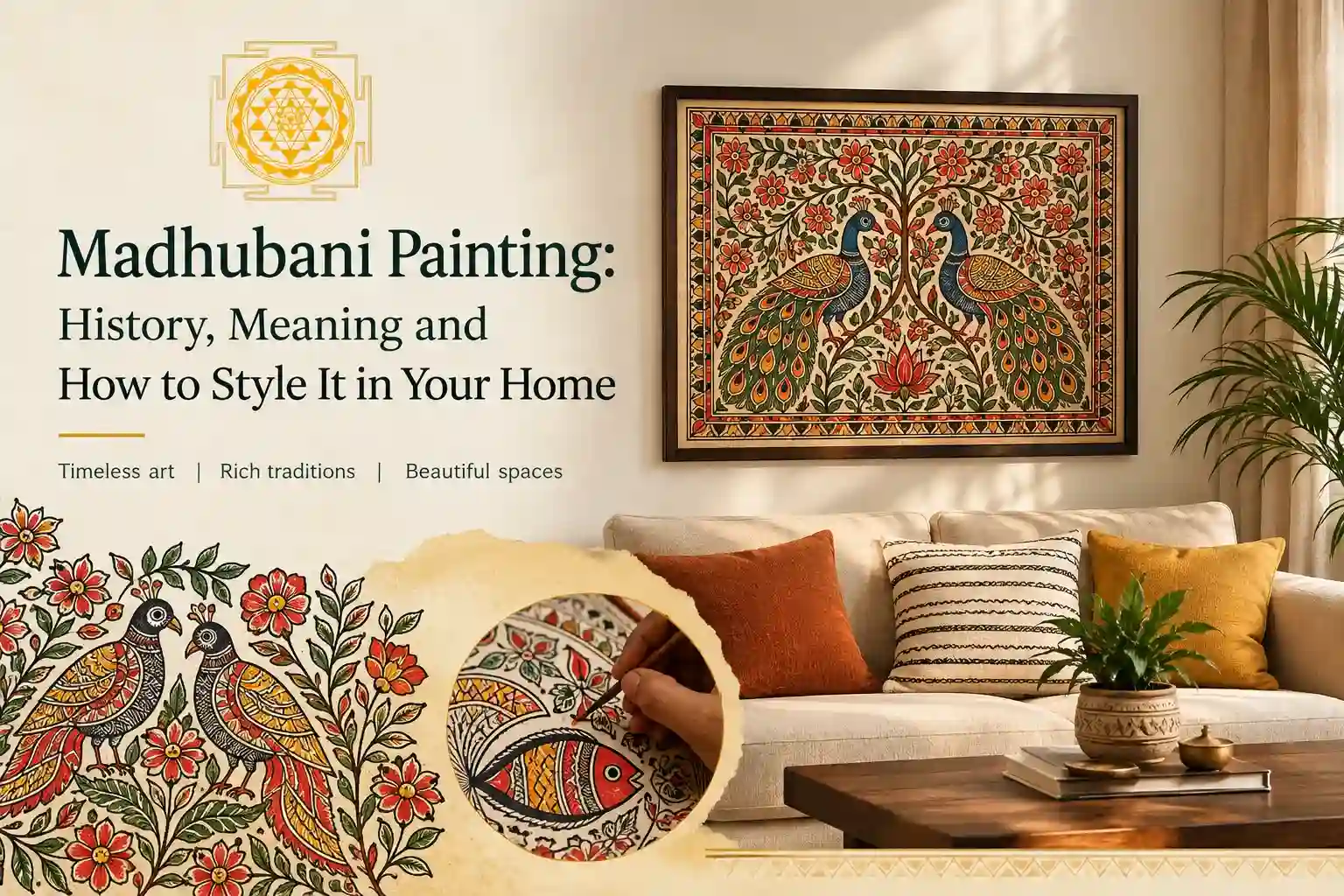
A beautiful painting can do more than fill an empty wall. It can bring colour into a room, start a conversation and connect us with a story that began long before the artwork reached our home.
Madhubani painting does all three.
Originating in the Mithila region of Bihar, India, this traditional art form is known for its intricate patterns, bold outlines, vibrant colours and meaningful imagery. You might notice fish swimming among flowers, peacocks surrounded by delicate lines or a tree filled with birds and leaves. Look a little closer, and the painting begins to tell a story.
Today, Madhubani art is appreciated by art lovers around the world. It can complement a traditional interior just as beautifully as a contemporary living space.
In this guide, we explore the history of Madhubani painting, the meaning behind its popular motifs, the different artistic styles and practical ways to display this distinctive Indian folk art in your home.
What Is Madhubani Painting?
Madhubani painting, also known as Mithila painting, is a traditional Indian folk-art form associated with the Mithila region of northern Bihar and adjoining areas of Nepal.
It is recognised for its detailed compositions, decorative borders, expressive figures and repeated patterns. Artists often draw inspiration from nature, mythology, religious traditions and everyday life.
One of its most distinctive features is the way the entire composition is developed. Instead of leaving large areas of the surface empty, artists often fill the background with flowers, leaves, lines, dots and other decorative details.
Traditional works may feature strong black outlines and rich colours. Other paintings rely on fine lines, hatching or more restrained palettes.
Madhubani art is not simply a decorative style. Its imagery reflects the experiences, beliefs and artistic knowledge of the communities that have kept the tradition alive across generations.
The History of Madhubani Painting
From the homes of Mithila to the wider art world
The roots of Madhubani painting lie in the domestic and ceremonial life of the Mithila region. Traditionally, women painted the walls and floors of their homes for weddings, festivals and other important occasions.
These paintings were connected to family life, celebration, nature and spiritual traditions. Designs were often passed from one generation to another, allowing artistic knowledge to continue within families and communities.
A popular local legend connects Madhubani painting with the wedding of Sita and Rama. According to this story, King Janaka asked for the celebration to be marked with decorated walls. Although this is an important part of the tradition’s cultural storytelling, it should be understood as a legend rather than a fully documented historical origin.
For generations, artists worked on walls and other surfaces within their homes. Over time, painting on handmade paper, cloth and canvas helped the art reach new audiences.
The transition to portable artworks also created opportunities for artists to sell their work and sustain their craft.
Today, Madhubani painting appears in private collections, galleries and contemporary interiors around the world. While the materials and settings may have changed, its intricate patterns and storytelling remain central to its appeal.
The women artists behind the tradition
Women have played a major role in preserving and developing Madhubani painting.
Much of the traditional knowledge was shared within families, with techniques, motifs and artistic approaches passed between generations. As the art gained wider recognition, individual artists began receiving greater visibility for their work.
Their contribution matters because Madhubani painting is not an anonymous decorative pattern. It is a living tradition shaped by people, communities and individual creative choices.
When choosing a Madhubani artwork, take a moment to learn about the artist whenever that information is available. Understanding who created a painting can make the experience of owning it more meaningful.
What Do Madhubani Painting Symbols Mean?
One of the most interesting aspects of Madhubani art is its use of recurring motifs. Animals, flowers, plants and religious figures can help communicate ideas about nature, relationships, celebration and spirituality.
However, meanings are not always fixed. They can vary according to the artist, the community, the occasion and the wider composition.
1. Fish: Life, prosperity and abundance
Fish are among the recognisable motifs in Madhubani painting.
In many Maithil cultural contexts, they are associated with fertility, prosperity and good fortune. Their curved bodies and repeating scales also create beautiful patterns that work naturally within the detailed style of the art.
A fish-themed painting can introduce movement and colour into a dining area, hallway or living room.
2. Peacocks: Beauty and expression
Peacocks often appear with elaborate feathers and carefully repeated lines.
They can be associated with beauty, love and nature, although their meaning depends on the particular artwork. Their distinctive shapes also make them visually striking, especially in paintings with bright colours and intricate borders.
A peacock composition can work well as a focal point in a room with relatively simple furnishings.
3. Lotus flowers: Growth and renewal
The lotus is a familiar symbol across several Indian artistic and spiritual traditions.
Depending on the context, it can suggest purity, renewal, beauty or spiritual growth. In Madhubani paintings, lotus flowers may appear alongside fish, birds, deities and decorative patterns.
A lotus-themed artwork can bring a sense of balance to a bedroom, reading corner or quiet personal space.
4. Trees and plants: The connection with nature
Trees, vines, leaves and flowering branches are common sources of inspiration.
A tree of life composition, for example, can bring different forms of nature together within a single design. Birds, leaves, flowers and branches may represent the interconnectedness of living things.
For a home with natural materials, wooden furniture or indoor plants, a nature-inspired Madhubani painting can create a pleasing visual connection.
5. Deities and mythological stories
Some Madhubani paintings depict figures such as Krishna, Rama, Sita, Shiva, Parvati or Ganesha.
These works may communicate stories and beliefs that are important within Hindu traditions. They can hold personal, devotional or cultural significance for the people who choose them.
When selecting religious artwork, consider its context and the place where you intend to display it. Choose a piece that reflects your appreciation of its subject and treat it with the respect you would give any meaningful cultural object.
The Main Styles of Madhubani Painting
Madhubani painting includes several styles. Their characteristics can overlap, and individual artists may interpret traditional techniques in their own ways.
Bharni style
Bharni is known for its use of filled colour. Artists often create clearly outlined figures and fill them with vivid shades.
This style can be a good choice if you enjoy expressive artwork with a strong visual presence.
Kachni style
Kachni, also written as Katchni, uses fine lines, hatching and repeated strokes to develop detail and texture.
The effect can be intricate without relying entirely on large areas of colour. It is worth exploring if you appreciate detailed linework.
Tantric and Kohbar traditions
Some Madhubani works draw on spiritual imagery, while Kohbar paintings are associated with wedding rituals and symbolism in the Mithila region.
These are related but distinct contexts. The term Kohbar is particularly connected with marriage traditions and imagery associated with the wedding chamber.
Godna style
Godna draws inspiration from traditional tattoo patterns. Repeated lines and geometric motifs help create a distinctive visual rhythm.
Its patterned approach can appeal to people who enjoy graphic compositions and detailed designs.
These labels are useful starting points, but they do not describe every Madhubani painting. If a particular style interests you, look at the individual artist’s approach as well.
How to Style Madhubani Painting in a Modern Home
You do not need a traditional interior to enjoy Madhubani wall art. The key is to give the artwork enough space to stand out while making sure it feels connected to the rest of the room.
1. Make it the centrepiece of your living room
A living room is an excellent place to display a painting that has a story to tell.
Consider hanging a larger Madhubani artwork above a sofa, console table or sideboard. Choose a piece whose colours work with the existing room, whether that means warm earthy tones, vivid reds and yellows or a more restrained palette.
If the painting has a dense pattern, keep nearby cushions and decorative accessories relatively simple. This allows the artwork to become the natural focal point.
Styling tip: Measure the wall before choosing a painting. A piece that is too small can feel disconnected from the furniture, while one that is too large may dominate the space.
2. Add character to your bedroom
For a bedroom, look for a painting that complements the atmosphere you want to create.
Nature-inspired compositions featuring flowers, birds or trees may work well with soft furnishings and natural materials. If you prefer bold colours, a more vibrant piece can create an interesting contrast against a neutral wall.
You could hang a smaller painting above a chest of drawers or place a framed piece on a dressing table or shelf, provided it is secured safely.
The aim is not to match every colour perfectly. Sometimes, a little contrast is what makes a room feel personal.
3. Create a welcoming entrance
The entrance to your home is an opportunity to introduce your taste in art.
A Madhubani painting can sit above a console table or on a wall near the entryway. Fish, flowers, birds and geometric compositions can all work well, depending on the size of the space.
In a narrow hallway, consider a smaller or vertically oriented artwork. Good lighting can help bring out the detail without making the area feel crowded.
4. Bring creativity into a home office
A home office does not have to be purely functional.
A small Madhubani painting can introduce colour and visual interest near a desk or reading area. Line-based compositions may suit a restrained workspace, while a colourful painting can add personality to a neutral room.
Choose a position where the artwork is easy to enjoy but does not interfere with your work or create distracting reflections on a screen.
5. Build a thoughtful gallery wall
If you enjoy collecting art, consider combining Madhubani painting with other works.
You could pair it with contemporary Indian art, a landscape painting, a botanical print or a photograph. The artworks do not need to share the same subject. A consistent frame style, a complementary colour palette or a balanced arrangement can help them feel connected.
Before putting nails in the wall, arrange the pieces on the floor or create paper templates to test the layout.
Remember that Madhubani paintings often contain intricate details. Leave enough space between works so that each piece can be appreciated individually.
How to Choose the Right Madhubani Painting
Choosing artwork is personal, but a few practical considerations can make the process easier.
Think about the colours in your room
Look at your wall colour, furniture, rugs and soft furnishings.
A colourful painting can stand out against a neutral background. A more restrained composition may work well in a room that already contains strong colours or patterns.
There is no need to match every shade. Look for a relationship between the artwork and the room rather than an exact colour match.
Choose the right size
Measure the wall and consider the furniture beneath it.
For a painting above a sofa, the artwork should relate visually to the width of the furniture. For smaller walls, a compact piece or a pair of paintings may be more suitable.
If you are buying online, check the listed dimensions carefully. Product photographs can make artwork appear larger or smaller than it is.
Understand the materials
Madhubani paintings may be created on handmade paper, cloth, canvas and other surfaces.
Ask about the materials, pigments, finish and framing when these details are not included in the product description. The surface and medium can affect how the painting looks and how it should be cared for.
Look for information about the artist
When available, read the artist’s biography and the description of the artwork.
Information about the artist, technique, materials and place of creation can help you understand what you are buying.
Be cautious of descriptions that use words such as “authentic,” “original” or “handmade” without explaining what they mean for that particular product.
Understand the difference between original paintings and prints
An original painting is a work created by an artist, while a print is a reproduction of an image. Both can be attractive choices, but they are not the same product.
If you are looking for an original Madhubani painting, check whether the seller explicitly identifies it as an original work and provides relevant details.
A clear product listing should explain the medium, dimensions, artist information where available, framing and delivery arrangements.
How to Care for Your Madhubani Painting
With the right care, you can enjoy your artwork for years.
- Avoid direct sunlight: Prolonged exposure can fade some pigments and damage the artwork.
- Keep it away from moisture: Bathrooms, damp walls and areas with frequent temperature changes may not be suitable for many paper-based paintings.
- Dust carefully: Follow the artist’s or seller’s instructions. Avoid applying water or household cleaning products to the painted surface.
- Choose suitable framing: Paper-based works may benefit from protective framing and materials appropriate for artwork preservation.
- Handle with clean, dry hands: Hold the frame or edges where possible, rather than touching the painted area.
- Check the hanging position: Secure the artwork properly and avoid placing it where it may be knocked or exposed to heat.
If you own a particularly valuable or delicate painting, ask a professional framer or conservator about appropriate protection.
Why Madhubani Painting Still Matters Today
Part of the appeal of Madhubani painting is its ability to connect the past with the present.
Its traditional imagery can sit comfortably in contemporary interiors, but the art offers more than visual interest. It reflects a cultural heritage shaped by artists who have preserved and developed the tradition over generations.
Choosing a painting with an understanding of its background can make the experience more rewarding. It encourages us to look beyond colour and pattern and consider the people, stories and artistic decisions behind the work.
It is also worth remembering that traditional art forms continue to evolve. Artists can honour established techniques while exploring new subjects, materials and compositions.
A modern setting does not make Madhubani painting less meaningful. What matters is recognising its roots while appreciating the creativity of the people who practise it today.
Frequently Asked Questions About Madhubani Painting
What is Madhubani painting?
Madhubani painting, also known as Mithila painting, is a traditional Indian folk-art form associated with the Mithila region of Bihar and adjoining areas of Nepal. It is known for detailed patterns, bold outlines, decorative borders and imagery inspired by nature, mythology and everyday life.
What is the meaning of Madhubani painting?
The meaning depends on the artwork and its context. Common motifs include fish associated with prosperity and abundance, lotus flowers connected with purity or renewal, and trees that evoke nature and interconnected life. Religious and ceremonial paintings may carry additional meanings.
What are the main styles of Madhubani painting?
Commonly discussed styles include Bharni, Kachni, Tantric, Kohbar and Godna traditions. They differ in their use of colour, linework, patterns, imagery and cultural context.
Where should I hang a Madhubani painting?
Popular locations include the living room, bedroom, hallway, dining area and home office. Consider the size of the wall, the surrounding colours, the lighting and the artwork’s subject when choosing a location.
Is Madhubani painting suitable for a modern home?
Yes. Its patterns and colours can complement contemporary interiors. A single statement piece can work well in a minimalist room, while smaller works can be incorporated into a gallery wall or a more colourful interior.
How can I choose a Madhubani painting online?
Check the artwork’s dimensions, medium, framing details, artist information, product photographs, delivery arrangements and returns policy. If you want an original painting rather than a print, confirm that the product description clearly identifies it as an original work.
Discover the Beauty of Indian Art
A Madhubani painting can bring colour, detail and a sense of cultural connection into your home. Whether you are drawn to the intricate lines of Kachni, the vivid colours of Bharni or the natural imagery found in many compositions, there is plenty to explore.
The best place to begin is with an artwork that genuinely speaks to you. Consider its story, the artist’s approach and the space where you would like to display it.
Explore the traditional and contemporary Indian paintings available at TheIndoBritArts.com to discover artwork that suits your home and your personal taste.